Tuesday, January 29, 2019

Immigrants Amid the Opulence Long Ago

by Brian T. Lynch, MSW

This is a story of two Irish immigrants who came to America during a different era. Thomas Lynch was from Clonmore, County Meath, and Ellen (Nellie) McGeever was from Doocastle, County Mayo.

Around 1914, during the heart of the Progressive Era, America was rife with turmoil, social activism and political reform from which would soon emerge America’s middle class. Yet even then the embers of the Gilded Age glowed brightly in areas where families of enormous wealth played out their lives of regal excess. During the Gilded Age, the wealthy elite built impressive country estates at which they entertained the rich, famous, and powerful figures of the day.
screen shot 2019-01-29 at 5.13.02 pm
The Florham Estate in Madison, New Jersey, was one such home.  Built between 1892 and 1899 by Hamilton Twombly and his wife, Florence Vanderbilt, the Florham mansion was the 8th largest home in America. Today the estate is a beautiful college campus, but around 1914 the Florham Mansion was still a mecca of high society.

By contrast, Ireland around 1914 was a fairly dismal place, especially in the countryside where prospects for a better life were nil and subsistence living was the norm. Ireland was still under British rule and the “Irish Question” hung in the air. That question was about how to transform these brutally subjugated people into a semi-autonomous country after nearly 800 years of British rule. Many of the Irish youth couldn’t wait for the answer. They hitched their fate to the “American Dream” and boarded ships to the United States. My future grandparents were among those young dreamers. Nellie McGeever from County Mayo on the west of Ireland and Thomas Lynch from County Meath in the east set sail for America not knowing each other and not knowing what to expect when they got here.

It wasn’t until my second semester at Fairleigh Dickenson University in 1972 that my father casually mentioned how ironic it was for me to be walking the same grounds where my grandparent met. He told me my grandmother was a cook and my grandfather a chauffeur for the Twombly’s. My aunts later confirmed this as true. I have pieced together a bit more history since, but never felt a real sense of that family history until my sister and I went to see the mansion this January.

My grandfather, Thomas Lynch, was born in 1891, one of thirteen children of Peter Lynch (b.1846) and Catherine Cusick (b.1862). His passage to America was preceded by several of his older brothers who rented a house at 4 Albert Avenue in Morris Township. Ironically, many years later my father would use his GI bill from WW II so his parents could buy that home where they lived the rest of their lives. It was the home my family visited often when I was a boy.


screen shot 2019-01-29 at 5.13.30 pm
On February 23, 1919, Thomas and Nellie married at the Church of the Assumption in Morristown. Their attendants were Thomas’s brother John Lynch and Nellie’s sister Hanorah (Nora) McGeever. One day in late January or early February of 1920, Thomas and Nellie boarded a White Star-Dominion Line ship named “The Baltic” to returned to Ireland where they planned to raise a family. Nellie's sister Nora McGeever was also on board heading back to Ireland with them. The couple arrived in Liverpool, England on the 9th of February, 1920, but sadly, Nora died on board the ship five days earlier.

screen shot 2019-01-29 at 11.42.39 am
Thomas and Nellie settled in a small cottage located on a “bohereen,” (Irish: bóithrín, meaning "a little road", is a country lane) near the little village of Kildalkey, County Meath. There they had my father, Peter, and four girls, Nora, Kathleen, Rosie and Elizabeth.

[http://www.kildalkeyvillage.com/gallery.html#pic25]


When my sister Patty and I were young, grandpa was a somewhat short old man with thick white hair and piercing blue eyes. He always wore trousers, suspenders, a white shirt and a vest where he kept his silver pocket watch on a long chain. He smoked a pipe and he had such a thick Irish brogue that I sometimes couldn’t understand him. He kept beautiful flower beds in the backyard and carefully tended his rose bushes by the white rail fence out front.

But granny was always the central figure. She was a bit plump with soft round features that belied her underlying strength of personality. She always wore long flowered dresses and shoes with thick, short heals. She never wore shorts or pants. She had dark grey hair kept under a hair net. She was the center of activity, which often involved food. Watching her moving about in her kitchen was my favorite pastime during visits. She would put on a clean linen or a flowered apron and move around so quickly and easily it was like a dance. She was organized and never unsure of what she had to do next. When she made Irish Soda bread she measured everything by eye or by feel and made it look quick and easy. She whipped up custards and soufflés and made different sauces for the meats and vegetables she served during the holidays. Her cakes and desserts were beautiful and tasted amazing. Little did my sister and I know that this wasn’t typical Irish fare.

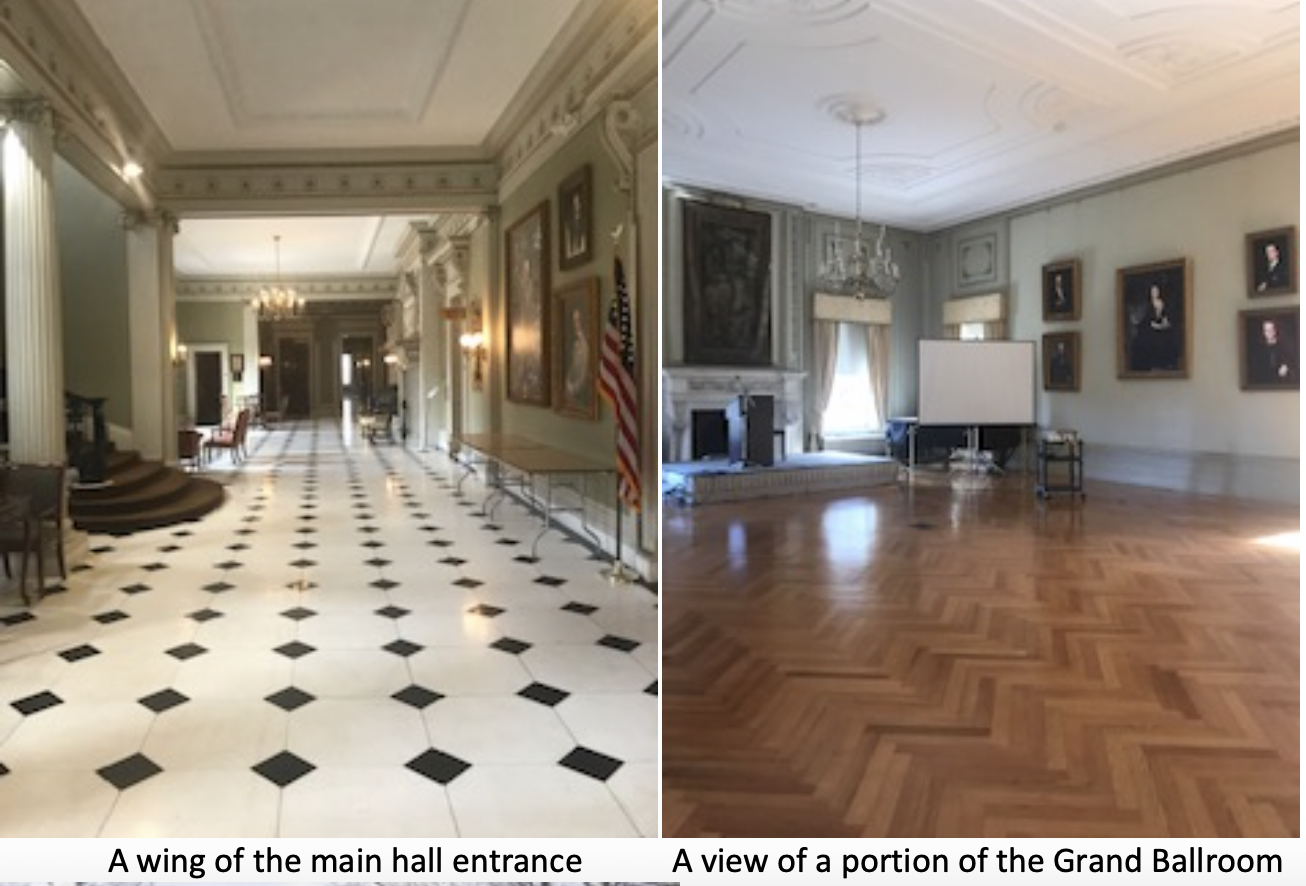
Our January visit to the Twombly mansion in 2019 was my sister’s first. Her enthusiasm was infectious. We walked around the elegant hallway, stared at the portraits and marveled at the Grand Ballroom. Patty wanted to see the kitchen but I had no idea where it was. She walked into one of the offices and met Mark, who works there. She introduced us as the grandchildren of two former servants which prompted him to tell us about the building and the times when they had worked there.

screen shot 2019-01-29 at 5.14.59 pm

Mark told us how to find where the kitchen had been and about all the other rooms we would visit as we walked about. We learned that the barn-like building where our grandparents lived was still standing behind the Science Center. Across from it still stands a row of garages where twelve maroon Rolls Royces and other automobiles were kept. My grandfather would have worn a matching maroon livery uniform when he drove those cars. He told us there was once a tunnel between the servant’s quarters and the basement of the mansion where my grandmother and other servants would walk back and forth so they wouldn’t be seen on the grounds of the Estate.

Perhaps most surprising of all, we learned that Nellie Lynch worked under the wealthiest and most famous private chef in the world.  Joseph Donon was a world renown chef who once fought for France during World War I. He was hired by Mrs. Twombly in 1917 to fulfill her request to give her “the best of the best.” He replaced most of the kitchen staff and hired his own workers who were loyal to him. Nellie may have stayed on because we have never heard of her working anywhere else before she married Thom.

Our recent visit to the Florham Estate made our family history come alive. We have a better idea of who these two immigrants and the social influences that help mold them.

screen shot 2019-01-29 at 5.15.31 pm
screen shot 2019-01-29 at 5.15.53 pm The red building to the left is where the servants lived on the Twombly Estate. Directly across the driveway is a long row of garages where The Twombly’s many cars were stored and maintained.


screen shot 2019-01-29 at 5.16.23 pm

A picture of the mansion and grounds that was taken about a third of the distance to the servant’s quarters. A tunnel under this area allowed the servants to enter the home without being seen.

Florham Campus: A History of the Estate

https://view2.fdu.edu/campuses-and-centers/florham-campus/about-the-florham-campus/florham-campus-a-history-of-the-estate/

Thursday, January 17, 2019

Obsessive Political Delirium Syndrome – Confessions of a Chronic Sufferer


by Brian T. Lynch, MSW


What follows is a post from the Humans of New York Facebook page that unfortunately resonated with both my daughter and me. I recognized this account as a satirical description of what I call “Obsessive Political Delirium” syndrome:

“I had three bottles of wine on election night. I got in bed after Pennsylvania and stayed there for a week. I’d only get up to use the bathroom and get more wine. I’d have left the country by now if it wasn’t for my elderly mother. I’ve weaned myself off Xanax, but I haven’t recovered.

I still watch MSNBC all the time. I’ll spend entire days on the couch. I’ll wake up with Morning Joe and go to sleep with Brian Williams. I’ll get on Twitter during the commercials and search for any hint that somebody’s going to be indicted. I know way too much. I know the name of every congressman. I know their district. I know what percentage of the vote they got.

Before 2016, I hadn’t purchased a book in twenty years. Now I buy all the political ones. The scarier the better. I even got the Omarosa book. Nobody else wanted to read it so I thought I’d take one for the team. I went to DC for four different protests.

And a few weeks ago I drove down to Mexico to see for myself what was happening on the border. I’m obsessed. It’s not healthy. Recently I was able to cut myself off from politics for about a week. But then here comes Brett Kavanaugh and I’m back on the couch for three days.”

The malady described above first gripped me when Richard Nixon won the Presidential election in 1964. His politics and creepiness consumed my attention right up until his impeachment. My political worrying was debilitating and depressing. It also triggered a secondary obsession over the prior assassinations of two Kennedys and a King. I have never been able to shake the feeling that those assassinations are the start of a long thread that has run through U.S. history ever since.

No sooner had I gotten my life back under control when WHAM! Ronald Reagan was elected. He surrounded himself with some of the same creeps and spooks that buzzed around Nixon. That bout of fibral political delirium peaked with the Iran-Contra scandal and dissipated slowly due to the very dissatisfying lack of another well-deserved impeachment.

Then I went into a deep political slumber for a while, and it was glorious. But one evening a CBS news special to explain this new White-Water scandal failed to reveal anything at all of substance. I remember thinking, "OH GOD! Not again!" Here was another rogue’s gallery of radical neo-cons and dirty tricksters flexing their new conservative media machines. They were out for a revenge impeachment of Bill Clinton, and they got it. Clinton wasn't convicted in the Senate, of course, because well... lying about a blow job to protect your reputation isn't exactly a high crime. Still, the dark forces behind the conservative façade got their pound of flesh.

After that I thought I would catch a break, but then Bush v. Gore happened.  I went nuts all over again about the stolen election and the discovery that electronic voting machines were craftily designed to be hacked. All the voting machine companies were owned by partisan Republicans at the time. That bout of the infliction culminated in my having to hire a First Amendment Lawyer to protect me from a threatened SLAPP suit by the company that ran our local elections, and a threatened criminal investigation of me by my county Prosecutor for bringing our local electronic voting machine vulnerabilities to the attention of our county government. I fended off the SLAPP suit (incurring legal fees) but it had its intended effect on me. I shut up about local politics.

I set out to cure myself of obsessive political delirium and was just starting to make good progress when Donald Trump started winning primaries. And OMG… here we are in the thick of the worst political disaster in our country’s history, with a President who is a “Clear and Present Danger” to the security of the United States.

I feel so bad for my children who have come down with this horrible affliction. I have suffered from recurring bouts of it my whole adult life. And the trauma now is greater than at any time in the past. Is this the final festering of an old injury that began with Kennedy’s assassination, or is it the end of America as we know it? I take some solace in the results of the 2016 Congressional election that has installed so many women and such great diversity into the House of Representatives. I also take comfort in the rising activism of a younger generation, including Parkland survivors, that sees things the same way I do. For my children’s sake, I hope that my hope for the future will be realized this time.

Tuesday, January 15, 2019

CYBER WARFARE EXPLAINED - How We Are Being Manipulated

by Brian T. Lynch, MSW

CYBER WARFARE EXPLAINED: Using various traditional and high tech methods, political and social divisions are being created and amplified in the US and other Western nations by the enemies of democracy and civilian rule. The divide created in this DISINFORMATION war is an INFORMATION divide. If you can divide a large group of people on what they believe to be true, they are beyond reach in a rational policy argument. Here is an overly simplified overview of the Cyber Warfare strategy:


- First, saturate the media environment of a disaffected subgroup of the population with an internally coherent set of altered facts that are attractive to them. Drown out the mainstream, traditional media information sources.

-Create suspicion and distrust of traditional news and journalistic institutions and of government and democratic institutions. Increase the target groups reliance on alternative media sources.

- Then go about influencing and developing the opinions of those who accept these altered facts by creating false narratives and seeding the alternative media with coordinated messaging.

- Next, manipulate and agitate the emotional states of the target population with manufactured scandals and elaborate conspiracy theories directed against those on the other side of the information divide.

- Reward this targeted group when their social media responses affirm the false narratives the alternate messaging on social media.

- Foster and a sense of loyalty among believers in the targeted group (creating in effect a tribalistic peer group of like-minded "patriot").

- Now the divide becomes difficult to breach, tumultuous in its social discourse, aggressive in its behavior towards others outside their social group and self-sustaining (due to our natural human social dynamics).

- Create enough of these social and political divides within a nation's population and the country becomes ungovernable as a civil democracy. The country becomes vulnerable to the rise of authoritarian dictatorship.


Regretfully, I am just beginning to understand how we are being attacked. How we fight back and win is not yet clear to me.


Further Reading:

Russia InfoWar Attacks via US Social Media: https://aseyeseesit.blogspot.com/2018/12/russia-info-warfare-attacks-via-us.html

Mueller's Russia Indictment - A Condensed Summary
https://aseyeseesit.blogspot.com/2018/02/muellers-russia-indictment-condensed.html

Propaganda in the Digital Age - Mind Control on a Massive Scale:
https://aseyeseesit.blogspot.com/2017/03/propaganda-in-digital-age-mind-control.html

Sunday, January 13, 2019

New Research - Health Benefits of Fiber Expanding (this is not an ad)

by Brian T. Lynch, MSW

Two insightful science articles recently came out that are worth sharing, one on diet and the other on exercise. I will share the diet article first.

The link here and below is to an article about dietary fiber. There is an expanded understanding as to how fiber contributes to human health. As many of us know, fiber helps regulate our bowels which may play a role in lowering colon cancer rates. Fiber may reduce cholesterol, perhaps by absorbing and thus eliminating certain fats the body uses to make cholesterol in the body. And it might help reduce inflammation which helps prevent heart disease, etc. We know there is both soluble fiber and insoluble fiber that isn't digested in the body.

The BBC article linked here summarizes the latest research on how fiber actually works in the body to benefit our health. The biggest takeaway for me was the discovery that indigestible dietary fiber is the primary food source for our gut bacteria.

A diverse and balanced intestinal flora is essential to good health and that disrupting that balance can lead to diseases as well as infections like Merca, Sepsis, and death. It turns out that our gut bacteria act like miniature chemical factories producing all sorts of exotic substances that our body relies on to maintain our health, substances that our body cannot make on its own.

The recent trend has been to toss back a copious amount of probiotics, which contain large numbers of just a few of the thousands of strains of active gut bacteria. A regular regiment of ingesting these little buggers never made much sense to me. It does make sense to re-seed your bowels during or after a course of antibiotics that kills off these good bugs, but if the environment down there is healthy, few probiotic capsules containing live bacteria should be all that is needed. Flooding the gut with just a few strains of bacteria doesn't seem like a good way to achieve a balance.

Now I realize that feeding the bacteria that live in our intestines is a much better strategy to maintain a healthy digestive ecosystem, and dietary fiber is their food of choice for that purpose. The article goes on to talks about how much fiber we need and how to get it. It's worth reading.

Now the unanswered questions for me include; Are there high-quality fibers more inducive to good health and low-quality fibers that aren't as good for our intestinal flora? For example, is the psyllium fiber Metamucil less edible for gut bacteria than say, the fiber in an apple?

The link: https://www.bbc.com/news/health-46827426

Counter